Army ground guide hand signals are vital for effective communication, especially when verbal commands are impractical or dangerous. These signals, documented in TC 3-21.60,
facilitate coordinated movement and tactical responses, ensuring mission success and soldier safety during patrols and operations.
Importance of Hand Signals in Military Communication
Hand signals are paramount in military communication due to their silent nature, offering a crucial advantage in tactical scenarios where noise discipline is essential. Unlike radio communication, they are immune to electronic interference and cannot be intercepted by the enemy, ensuring secure command and control.
These signals enable rapid, unambiguous instructions during dynamic situations, such as patrols, ambushes, and close-quarters combat. They bridge communication gaps caused by distance, terrain, or equipment failure. The official Army guide, TC 3-21.60, emphasizes their role in maintaining unit cohesion and responsiveness.
Furthermore, hand signals are universally understood, transcending language barriers within multinational forces. Proficiency in these signals isn’t merely a skill; it’s a fundamental requirement for effective teamwork and mission accomplishment, directly impacting soldier survivability and operational effectiveness.
Historical Context of Hand Signals
The use of hand signals in military operations dates back centuries, predating modern communication technologies. Historically, armies relied on visual cues – flags, arm movements, and formations – to coordinate movements on the battlefield. These early signals were essential for maintaining order and executing maneuvers before the advent of radios and telephones.
During the American Civil War, signal corps utilized flags and semaphore for long-distance communication, but close-range commands still depended on established hand signals. The need for silent, reliable communication persisted through both World Wars and the Korean War, solidifying the importance of standardized visual signals.
The modern Army’s TC 3-21.60 builds upon this legacy, codifying a comprehensive system of hand signals refined through decades of practical experience. This evolution reflects the continuous adaptation of military tactics and the enduring need for effective, discreet communication on the ground.
Basic Hand Signals for Movement
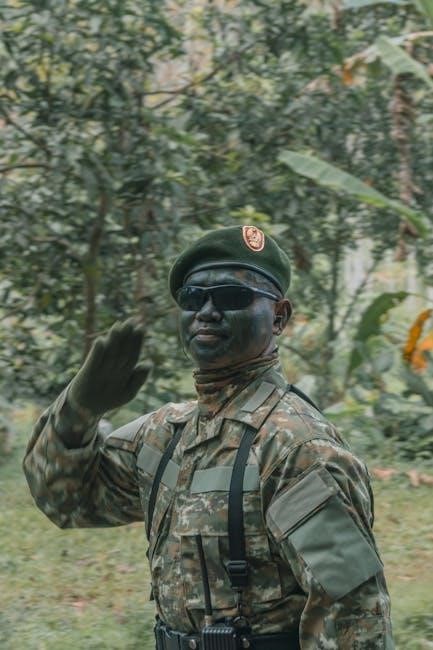
Army movement signals, like “Advance” (follow me) and “Halt,” are foundational for controlling troop positioning and pace during patrols and tactical maneuvers.
Advance (Follow Me)
The “Advance (Follow Me)” hand signal is a cornerstone of infantry movement, directing personnel to proceed forward under the leader’s guidance. This signal is executed by extending the arm straight out in the desired direction of travel, maintaining a consistent and clear indication for those following. The arm remains extended until the team acknowledges and begins movement, or until a subsequent signal is given.
It’s crucial that the leader maintains a steady pace and clear direction, ensuring the team can easily follow. This signal is particularly important during dismounted patrols, low-visibility conditions, or when noise discipline is paramount. Proper execution of this signal minimizes confusion and maintains unit cohesion, contributing significantly to operational effectiveness and safety. Consistent application of this fundamental signal builds trust and facilitates smooth, coordinated movement.
Halt
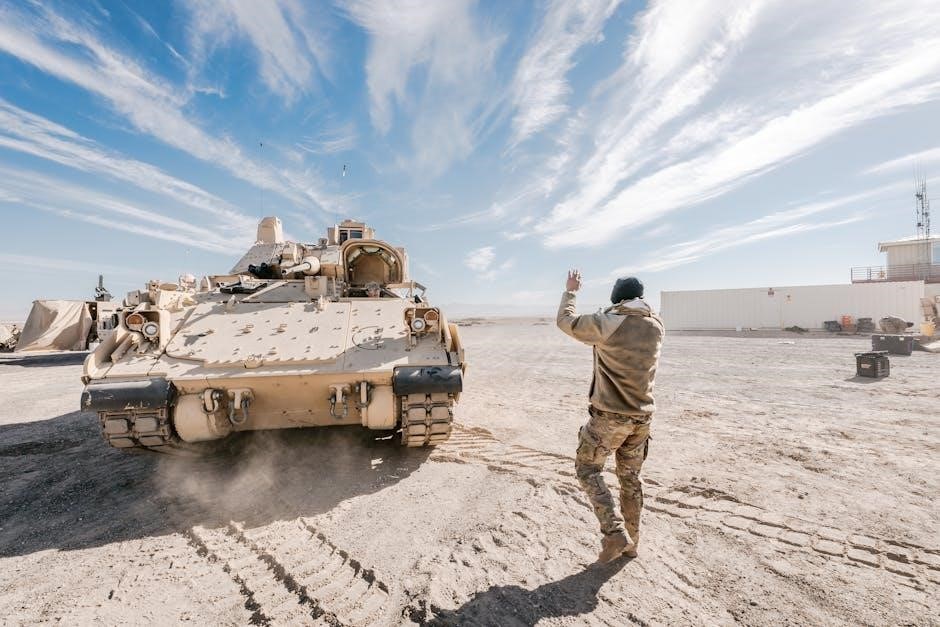
The “Halt” hand signal is arguably the most critical control signal in military movement, instantly stopping all forward progress. It’s performed by raising the hand upwards, palm facing forward, in a clear and decisive manner. This signal demands immediate obedience, requiring all personnel to cease movement and maintain their current positions.
Effective execution necessitates a distinct and unambiguous gesture, ensuring it’s visible to everyone within the unit. The signal must be held until acknowledged, typically with a raised hand in return, confirming understanding. This prevents miscommunication and ensures a synchronized response. The “Halt” signal is vital for reacting to unexpected threats, maintaining situational awareness, and controlling the pace of movement during patrols or tactical maneuvers. It’s a fundamental element of disciplined military conduct.
Double Time
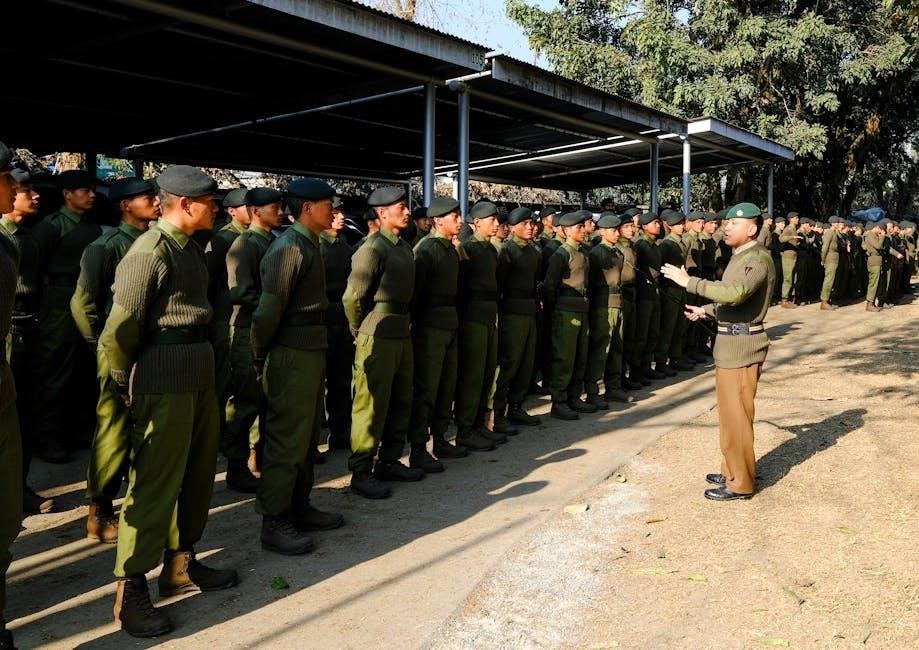
The “Double Time” hand signal signifies an immediate increase in marching speed to the fastest possible pace. It’s executed by forming a fist and extending the arm above the head, then rapidly bringing the fist down in a pumping motion, resembling a vigorous downward strike. This dynamic gesture clearly communicates the need for accelerated movement, often in response to a developing situation or to cover ground quickly.
The signal should be repeated several times to ensure clarity and is typically accompanied by a verbal command. Soldiers respond by immediately increasing their pace, maintaining proper form despite the heightened speed. This signal is crucial for reacting to enemy contact, maneuvering into advantageous positions, or responding to urgent tactical requirements. It demands physical exertion and disciplined execution from all personnel.
Decrease Speed
To signal a reduction in marching tempo, the “Decrease Speed” hand signal involves extending the arm horizontally at shoulder height, with the palm facing outwards. The hand then moves in a sweeping up-and-down motion, resembling a gentle wave, but crucially, the arm remains at shoulder level throughout the gesture. This controlled movement indicates a need to slow the pace without completely halting.
This signal is vital for maintaining formation integrity, navigating difficult terrain, or responding to changing tactical circumstances. It allows leaders to adjust the unit’s speed without disrupting the flow of movement. Soldiers acknowledge the signal by gradually reducing their pace, maintaining discipline and situational awareness. Clear execution prevents abrupt stops and ensures a smooth transition to a slower tempo.
Column Formation
The “Column Formation” hand signal directs personnel to arrange themselves in a single file line, one behind the other. This is achieved by extending the arm forward, palm facing downwards, and making a fist. Then, the hand rotates in a circular motion, mimicking the linear arrangement of a column. This formation is particularly useful for navigating narrow spaces, moving through dense terrain, or maintaining a low profile.
Column formation prioritizes speed and ease of control in restrictive environments. It minimizes the unit’s width, allowing for quicker passage through obstacles. Leaders utilize this signal to efficiently maneuver troops while maintaining situational awareness and minimizing vulnerability. Proper execution ensures a tight, orderly line, facilitating rapid movement and effective command and control.
Line Formation
The “Line Formation” hand signal instructs personnel to arrange themselves side-by-side in a straight line. This is executed by extending the arm horizontally, palm facing forward, and making a sweeping motion as if drawing a line across the front; This formation maximizes firepower and provides a broad front for observation and engagement.
Line formation is ideal for situations requiring a wide field of view or a concentrated volume of fire. It’s commonly employed during defensive positions or when conducting sweeps of open areas. Leaders use this signal to quickly establish a firing line or to present a formidable front to the enemy. Precise alignment is crucial for maximizing the effectiveness of this formation, ensuring coordinated fire and mutual support.
Wedge Formation
The “Wedge Formation” hand signal directs personnel to arrange themselves in a V-shape, with the leader at the point of the wedge. This is indicated by bringing the hands together in front of the chest, forming a triangular shape, and then extending them forward and outward. This formation is excellent for breaking through obstacles or pushing through enemy lines.
Wedge formations offer a balance of firepower and maneuverability, allowing for focused assault while maintaining situational awareness. It’s particularly useful in close-quarters combat or when navigating constricted terrain. The point of the wedge bears the brunt of initial contact, while the flanks provide supporting fire. Maintaining formation integrity is vital for maximizing the wedge’s effectiveness and preventing fragmentation.
Directional Hand Signals
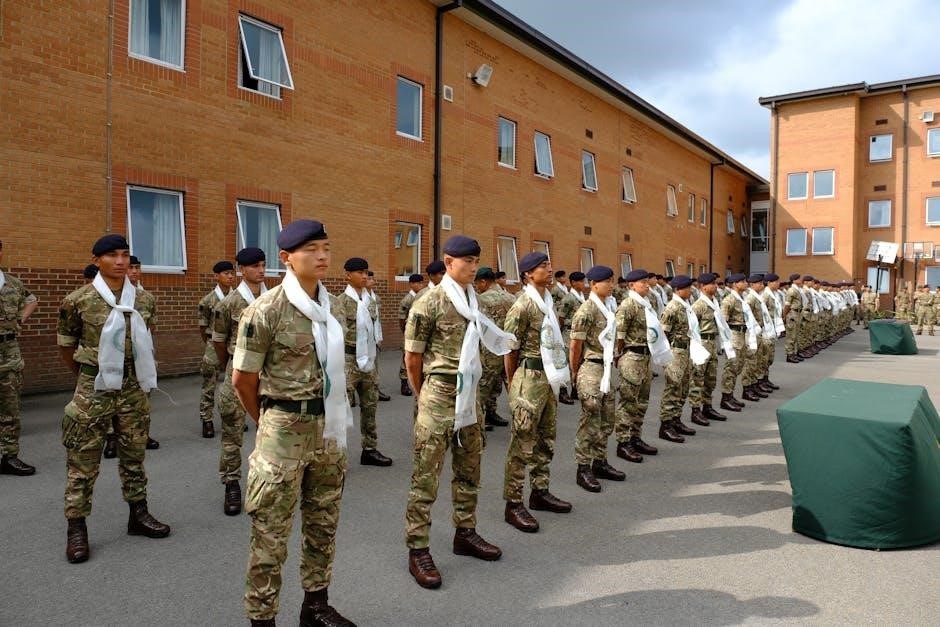
Directional hand signals guide movement, utilizing arm extensions and pointing to indicate desired routes or changes in direction for units and individuals.
Change Direction (Left/Right)
To signal a change in direction, whether left or right, the leader extends their arm outwards in the desired direction of travel. This is a fundamental signal for maneuvering units and maintaining formation integrity. For a left turn, the arm extends horizontally to the left, while a right turn is indicated by extending the arm horizontally to the right.
The signal must be clear and unambiguous, ensuring all personnel understand the intended course alteration. It’s crucial to maintain visibility of the signal, especially in challenging terrain or low-light conditions. This simple yet effective hand signal prevents confusion and ensures cohesive movement, vital for tactical operations and patrol efficiency. Proper execution minimizes delays and maximizes unit responsiveness during dynamic situations.
Turn Back
The hand signal for “Turn Back” is a crucial command for rapid reversal of movement, often employed when encountering unexpected threats or needing to reposition quickly. This signal involves forming a fist with the hand and rotating the forearm in a circular motion, resembling the action of screwing in a lightbulb.
The signal must be executed with deliberate clarity, ensuring all members of the unit recognize the immediate need to reverse their course. It’s vital to maintain visual contact throughout the maneuver, preventing disorientation and maintaining unit cohesion. This signal demands swift and precise execution, as delays can compromise tactical advantage or safety. Proper implementation ensures a coordinated and controlled retreat, minimizing vulnerability.
Follow That Person/Vehicle
To signal “Follow That Person/Vehicle,” the hand and arm signal directs a unit to maintain observation and proceed behind a designated individual or motorized transport. This is achieved by extending the arm outwards, pointing directly at the target – be it a person or a vehicle – and maintaining that direction.
The signaler must ensure a clear and unambiguous indication of the target, avoiding any confusion amongst the team. Maintaining visual contact with both the target and the responding unit is paramount. This signal is frequently used during reconnaissance, security patrols, or when shadowing potential threats. Precise execution ensures the unit remains oriented and maintains situational awareness while discreetly tracking the designated subject.
Tactical Hand Signals
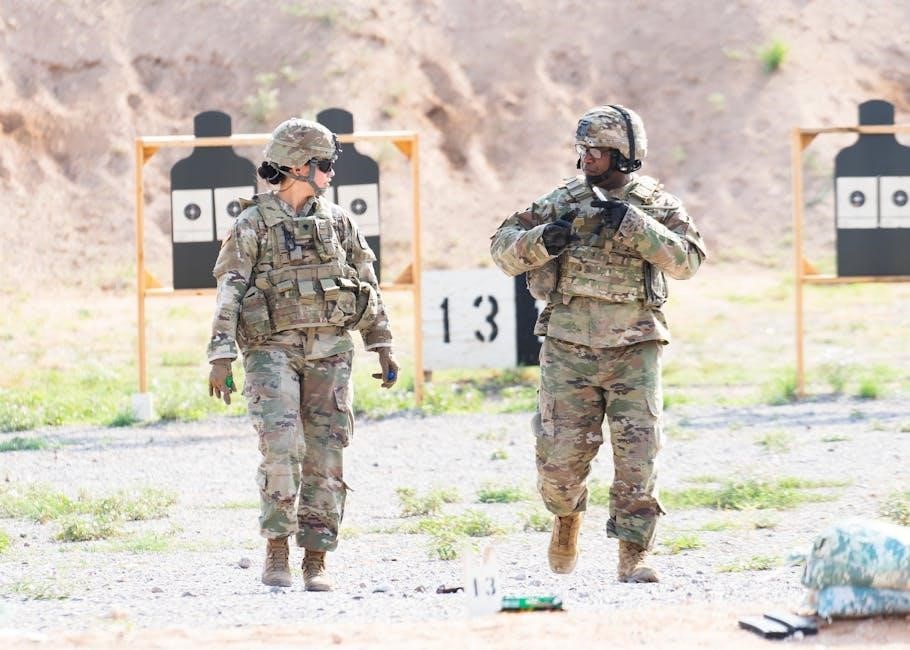
Tactical hand signals enable rapid, silent communication during critical situations, covering actions like assembling, dispersing, fixing bayonets, and alerting to enemy presence or incoming fire.
Assemble (Rally Point)
The “Assemble” or “Rally Point” hand signal is crucial for regaining unit cohesion, particularly after becoming dispersed during movement or engagement. This signal, visually represented by extending the arm upwards and sweeping it in a circular motion, directs all personnel to converge at a pre-designated rally point.
Effective execution of this signal relies on prior planning and clear communication of the rally point’s location. Soldiers must immediately recognize and respond to the signal, moving swiftly and cautiously towards the designated area. This signal is often employed during patrols, ambushes, or when navigating challenging terrain. It’s a fundamental element of maintaining control and accountability within a unit, ensuring a swift return to operational readiness. Proper understanding and execution are paramount for mission success and soldier safety.
Disperse
The “Disperse” hand signal is a critical command used to quickly break contact or reduce vulnerability to enemy fire. Executed by raising an open hand upwards and then waving it back and forth, it instructs personnel to immediately spread out and seek cover. This signal aims to minimize the impact of potential threats like artillery or small arms fire by presenting a less concentrated target.
Upon receiving the “Disperse” signal, soldiers should move rapidly and independently to pre-planned individual positions or utilize available terrain for concealment. Maintaining situational awareness is vital during dispersal, as is continued observation for enemy activity. This signal is frequently used during ambushes, when under fire, or when attempting to evade detection. Swift and disciplined dispersal can significantly enhance survivability and tactical advantage.
Fix Bayonets
The “Fix Bayonets” hand signal prepares soldiers for close-quarters combat, signaling an imminent engagement requiring immediate offensive capability. This signal is conveyed by gripping the rifle near the muzzle and making a stabbing motion forward with the weapon. It’s a clear and unambiguous directive, historically used to instill aggression and demonstrate readiness for hand-to-hand fighting.
Upon receiving this signal, soldiers swiftly attach their bayonets, transforming their rifles into formidable close-combat weapons. This action signifies a shift to a highly aggressive posture, often employed during assaults or defensive perimeters. While modern warfare sees less frequent bayonet charges, the signal remains a vital part of infantry training, representing a commitment to decisive action and close-range dominance. Proper bayonet fixation and handling are crucial for effectiveness.
Take Cover
The “Take Cover” hand signal is a critical life-saving measure, instantly communicating the need for immediate protection from enemy fire or potential hazards. This signal is executed by bringing the hand, palm down, over the head and moving it in a circular motion. It’s a universally understood directive, overriding all other actions and prioritizing self-preservation and unit survival.
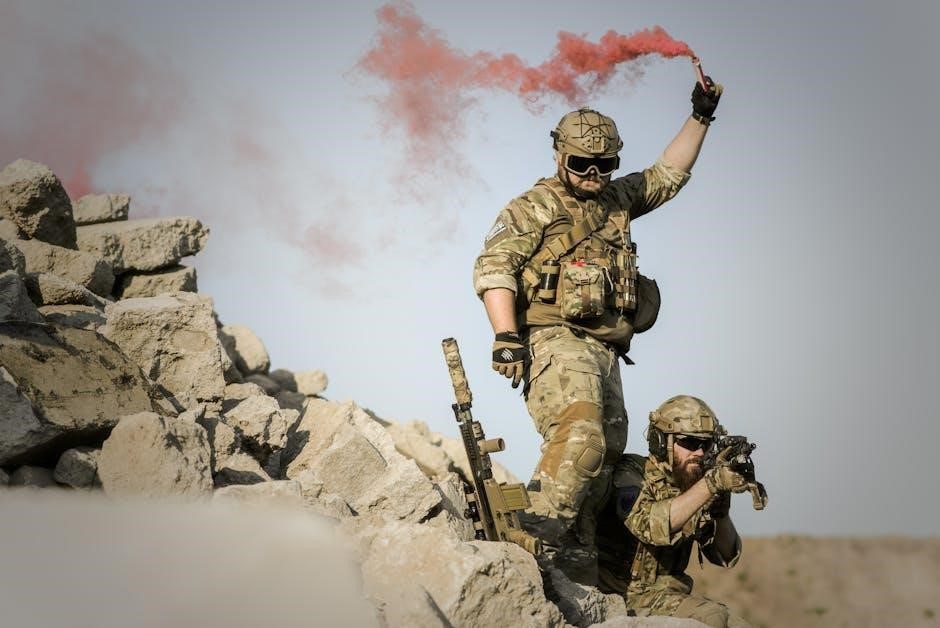
Upon receiving this signal, soldiers immediately seek the nearest available cover – ditches, walls, vehicles, or any substantial obstacle. Speed is paramount; minimizing exposure to enemy fire is the primary objective. This signal emphasizes situational awareness and rapid response to threats, fostering a culture of proactive safety within the unit. Effective cover reduces vulnerability and allows for assessment and counter-attack preparation.
Enemy in Sight (Direction & Type)
The “Enemy in Sight” signal is crucial for maintaining situational awareness and initiating a swift, coordinated response to threats. To indicate the enemy’s location, point directly towards them with an extended arm. Simultaneously, use hand gestures to convey the type of enemy observed – individual, group, or vehicle. A clenched fist can represent a single enemy, while an open hand sweeping across indicates multiple combatants.
Further clarification can be added; for example, mimicking a vehicle’s movement suggests an enemy vehicle. This signal demands immediate attention and triggers a threat assessment. Accurate and timely reporting of enemy presence allows for effective tactical maneuvering, defensive positioning, and potential engagement, significantly enhancing unit safety and mission success.
Incoming Fire!
The “Incoming Fire!” hand signal is arguably the most critical for immediate survival. It’s executed by rapidly circling the head with one or both hands, clearly indicating the threat of hostile projectiles – artillery, mortars, or direct fire. This signal demands an instantaneous reaction: soldiers must immediately seek cover, utilizing available terrain or fortifications.
Accompanying the hand signal, a shouted warning – “Incoming!” – reinforces the message. Precise execution is paramount, as hesitation can be fatal. Upon receiving this signal, personnel should drop to the ground, assume a protective posture, and assess the impact area. This rapid response minimizes casualties and allows for a coordinated assessment of the situation, enabling a return of fire or continued mission execution when safe.
Communication & Control Signals
Essential for maintaining order, these signals cover patrol guidance, status reports, and support requests, ensuring cohesive teamwork and effective command during operations.
Arm and Hand Signals for Patrols
Patrols heavily rely on silent communication, making hand signals paramount for maintaining stealth and coordinating movements. Signals like “Follow Me,” indicated by extending an arm forward, guide the team. Conversely, “Halt” is signaled with an upward-facing palm. Increasing speed, or “Double Time,” involves a clenched fist pumped downwards, while decreasing speed utilizes a waving arm at shoulder height.
Formations are communicated through specific arm positions; a closed fist indicates a column, while outstretched arms suggest a line. These visual cues minimize noise discipline breaches. Reporting status, requesting support, or altering the patrol’s course all depend on precise hand signal execution, ensuring clarity and preventing misunderstandings in dynamic environments. Mastering these signals is crucial for patrol leaders and team members alike.
Signals for Reporting Status
Reporting status effectively during patrols or operations relies on a standardized set of hand signals. A closed fist to the forehead signifies “All Present,” confirming personnel accountability. Conversely, a fist pointed upwards indicates “Enemy in Sight,” immediately alerting the team to a potential threat, often accompanied by directional indicators.
Signals also convey casualty reports; a hand mimicking a wound location communicates injury details. A thumbs-up signifies “Mission Accomplished” or a positive status update, while a thumbs-down indicates difficulty or failure. These concise visual cues minimize radio chatter, maintaining operational security and allowing for rapid assessment of the unit’s condition and progress. Accurate and timely status reporting is vital for informed decision-making.
Signals for Requesting Support
Requesting assistance swiftly and silently is crucial in dynamic battlefield scenarios, relying heavily on established hand signals. A clenched fist, moved back and forth, communicates the need for immediate support, often indicating a compromised position or overwhelming enemy presence. An open palm facing upwards signifies a request for ammunition resupply, vital for sustained engagement.
Further signals detail the type of support needed; circling the head indicates medical assistance, while pointing towards a specific direction requests covering fire. These signals minimize radio transmissions, preserving communication security and enabling rapid response from supporting elements. Clear and concise requests, conveyed through standardized hand signals, dramatically increase the likelihood of successful mission outcomes and soldier survivability.

Advanced Hand Signal Techniques
Mastering silent protocols, low-visibility adaptations, and signal combinations elevates communication proficiency, enabling complex message conveyance without compromising operational security or awareness.
Silent Communication Protocols
Effective silent communication relies on precise execution and mutual understanding of established hand signals. These protocols are paramount when noise discipline is critical, such as during stealthy movements, observation posts, or when facing a potentially hostile environment. Minimizing auditory cues prevents detection by the enemy, preserving the element of surprise and enhancing operational security.
Training emphasizes smooth, deliberate movements, avoiding jerky or exaggerated gestures that could attract unwanted attention. Signals must be clear, concise, and easily distinguishable from one another, even under stressful conditions. Teams often practice signal drills repeatedly to build muscle memory and ensure seamless communication. Furthermore, understanding the terrain and utilizing natural concealment can aid in discreet signaling, maximizing the effectiveness of silent protocols and minimizing risk.
Hand Signals in Low-Visibility Conditions
Operating in darkness, fog, or dense vegetation demands adaptations to standard hand signal procedures. Increased signal size and slower execution rates become crucial for visibility. Signals should be performed in a manner that maximizes contrast against the background, utilizing available light sources cautiously to avoid detection. Illuminated signals, like using a flashlight briefly, require strict control to prevent compromising the unit’s position.
Tactical considerations dictate the use of tactile signals – physically touching a comrade to convey information – when visual communication is impossible. Pre-arranged taps or squeezes can substitute for hand gestures. Maintaining close proximity is essential for tactile communication, but also increases vulnerability. Thorough training and consistent practice are vital to ensure accurate interpretation of signals in challenging low-visibility environments, preserving team cohesion and operational effectiveness.
Combining Signals for Complex Messages
Effective communication often requires conveying more than simple commands. Combining basic hand signals allows for the transmission of complex information, enhancing tactical flexibility. For instance, a “halt” signal followed by a directional signal can indicate a specific rally point. Sequencing signals – performing one after another – builds layered instructions, minimizing ambiguity and maximizing clarity.
Experienced leaders utilize signal combinations to relay nuanced details about enemy positions, terrain features, or mission objectives. This demands a shared understanding of signal protocols within the unit. Careful consideration must be given to signal timing and execution to avoid misinterpretation. Proficiency in combining signals represents a higher level of communication skill, enabling swift and precise responses in dynamic operational environments, ultimately improving mission outcomes.
Resources and Further Learning
For comprehensive study, consult TC 3-21.60, the official Army hand signal guide. Numerous online resources and flashcards, like those available now, aid in mastering these vital skills.
TC 3-21.60: Official Army Hand Signal Guide
TC 3-21.60 stands as the definitive resource for understanding and implementing Army ground guide hand signals. This training circular meticulously details a comprehensive suite of visual signals, serving as the foundational doctrine for military communication in scenarios where verbal commands are compromised. Originally published with updates like the March 2017 revision, it provides standardized gestures for movement, direction, tactical maneuvers, and communication control.
The guide isn’t merely a list; it explains the precise execution of each signal, emphasizing clarity and minimizing ambiguity. It covers signals for basic actions like “Halt,” “Advance,” and “Double Time,” alongside more complex commands for formations, enemy contact, and requesting support. Utilizing TC 3-21.60 ensures all personnel operate with a common understanding, fostering cohesion and effectiveness on the battlefield or during training exercises. Mastering these signals, as outlined in the circular, is paramount for every soldier.
Online Resources for Learning Hand Signals
Beyond the official TC 3-21.60, numerous online resources bolster understanding and practice of Army ground guide hand signals. Websites like Pew Pew Tactical offer detailed explanations and visual breakdowns of key signals, including nuances in execution – for example, the “Double Time” signal’s energetic arm movements. Flashcard sets, readily available online, provide a convenient method for memorization and quick recall, covering up to 100 essential signals.
Reddit’s r/coolguides occasionally features curated lists of tactical hand signals, though these often focus on simplified sets for close-quarters operations. Furthermore, platforms like YouTube host instructional videos demonstrating proper signal execution. These resources, while supplementary, are invaluable for reinforcing learning and ensuring proficiency, complementing the foundational knowledge gained from the official Army manual and aiding in practical application.