The Sullivan Ballou Letter: A Civil War Testament
Accessing the Sullivan Ballou letter in PDF format allows for detailed study and preservation of this poignant historical document, offering a tangible connection to the past.
Numerous online archives and historical societies provide downloadable PDF versions, ensuring widespread accessibility for researchers and enthusiasts alike, preserving its legacy.
These PDF files often include transcriptions alongside images of the original handwriting, facilitating both readability and scholarly analysis of the letter’s content.
Digitized copies in PDF format enable easy sharing and integration into educational materials, amplifying the letter’s impact on understanding the Civil War era.
The availability of the Sullivan Ballou letter as a PDF contributes to its enduring relevance, allowing future generations to engage with this powerful testament.
Historical Context of the Letter
The Sullivan Ballou letter emerged from the tumultuous backdrop of the American Civil War, penned in July 1861, a mere months after the conflict’s eruption at Fort Sumter. PDF versions of this letter allow modern audiences to connect directly with this era.
The early stages of the war were characterized by a surge of patriotic fervor, coupled with a grim realization of the immense sacrifices that lay ahead, vividly reflected in Ballou’s words. PDF accessibility enhances understanding.
Ballou, a Rhode Island attorney, volunteered for service with the 2nd Rhode Island Infantry, representing a wave of citizen-soldiers answering President Lincoln’s call to arms. PDF copies preserve the original intent.

The First Battle of Bull Run, anticipated at the time of the letter’s writing, loomed large, foreshadowing the brutal realities of warfare and the high probability of casualties. PDF formats aid historical research.
Communication during this period relied heavily on handwritten letters, serving as the primary means of connection between soldiers and their loved ones, making the PDF a valuable artifact.
The letter’s emotional depth and eloquent prose offer a rare glimpse into the mindset of a soldier facing imminent danger, a sentiment powerfully conveyed through readily available PDF resources.
Sullivan Ballou’s Biography
Sullivan Ballou, born in 1829 in Smithfield, Rhode Island, was a 32-year-old lawyer and businessman when the Civil War commenced, a detail often highlighted in analyses of the PDF of his letter.
He was a graduate of Brown University and Harvard Law School, demonstrating a background of intellectual pursuits before dedicating himself to military service, information readily available alongside PDF versions.
Ballou was a devoted husband to Sarah Hartwell, and a father, deeply cherishing his family life, a sentiment profoundly expressed in the letter now widely circulated as a PDF document.
Prior to the war, he actively participated in local politics and community affairs, showcasing a commitment to civic duty that extended to his decision to enlist, as explored in PDF companion materials.
His profession as an attorney instilled in him a refined writing style, evident in the eloquent prose of his final letter, easily appreciated through the clarity of a PDF reproduction.
Understanding Ballou’s background provides crucial context for interpreting the emotional weight and philosophical reflections contained within the letter, enhanced by access to the PDF format.
Ballou’s Military Service
Sullivan Ballou volunteered for service with the 2nd Rhode Island Infantry in April 1861, quickly rising to the rank of Major, a detail often noted when examining the PDF of his famous letter.
He was assigned to the Army of the Potomac and participated in early engagements of the war, including the First Battle of Bull Run, the impending conflict referenced in the PDF document.
Ballou’s unit was tasked with defending Washington D.C., a critical strategic objective during the initial stages of the Civil War, context provided alongside the PDF transcript.
His military service was relatively short-lived; he was tragically killed in action at the First Battle of Bull Run on July 21, 1861, a fact underscored by the letter’s status as his last, available in PDF form.
The circumstances surrounding his death cemented the letter’s significance, transforming it into a poignant symbol of sacrifice, readily accessible through the PDF version.
Studying his military record alongside the PDF of his letter offers a deeper understanding of the risks and realities faced by soldiers during the Civil War, enriching its emotional impact.

The Content of the Letter
The Sullivan Ballou letter, available as a PDF, reveals profound expressions of love, foreboding, and acceptance of potential death on the battlefield.
Opening and Initial Concerns
The Sullivan Ballou letter, readily accessible in PDF format, commences with a sense of impending action and a premonition of possible separation from his beloved wife, Sarah. He indicates strong expectations of an imminent military movement, potentially as early as the following day, revealing his anxiety about the unfolding events.
This initial concern drives his compulsion to write, fearing it might be his last opportunity to communicate with her, a sentiment powerfully conveyed within the PDF document. Ballou’s opening lines demonstrate a pragmatic awareness of the dangers inherent in warfare, coupled with a deep emotional need to connect with Sarah before facing potential conflict.
The PDF allows readers to observe the immediacy of his worry, as he prioritizes conveying his feelings before the possibility of being unable to do so arises, establishing a tone of urgency and heartfelt sincerity throughout the letter.
Expressions of Love for Sarah
Within the Sullivan Ballou letter, available as a PDF, a profound and unwavering love for his wife, Sarah, permeates every line. He repeatedly emphasizes the depth of his affection, stating that even in the face of death, her name will be the final whisper escaping his lips, a testament to their bond.
The PDF reveals a man utterly devoted, expressing a love that transcends physical presence and anticipates enduring beyond his potential demise. He implores Sarah to remember his love, framing it as a constant source of comfort even in his absence, a deeply moving declaration.
This fervent expression, easily observed within the PDF’s text, isn’t merely romantic; it’s a spiritual connection, a belief that their love will persist even beyond the earthly realm, solidifying its enduring power and emotional resonance.
Reflections on Potential Death
The Sullivan Ballou letter, readily accessible as a PDF, confronts the imminence of death with remarkable composure and philosophical depth. He acknowledges the strong possibility of perishing in battle, yet frames it not with fear, but with a sense of acceptance and resignation to fate, a poignant observation.
Examining the PDF reveals Ballou’s contemplation of his mortality, envisioning his final moments on the battlefield and the manner in which he might meet his end. He doesn’t dwell on the horror of war, but rather on the peaceful thought of his love for Sarah accompanying him.
This acceptance, clearly articulated within the PDF’s text, isn’t stoicism, but a profound understanding of the sacrifices inherent in war and a desire to find meaning even in the face of ultimate loss, making it a powerful reflection.
Acknowledging Faults and Seeking Forgiveness
The Sullivan Ballou letter, preserved in PDF format, demonstrates a remarkable level of self-awareness and humility as he anticipates his potential demise. He doesn’t present himself as a flawless hero, but openly admits to his imperfections and the pain he may have caused his wife, Sarah, a striking confession.

Within the PDF’s transcribed text, Ballou earnestly seeks forgiveness for his “thoughtless” and “foolish” actions, recognizing the burdens he placed upon her during their marriage. This isn’t a plea for exoneration, but a genuine expression of remorse and a desire for peace before facing death.
The PDF allows readers to witness this intimate moment of vulnerability, highlighting Ballou’s deep love for Sarah and his concern for her well-being even as he prepares for the possibility of never returning home, a truly heartfelt sentiment.
Detailed Examination of Key Phrases
The readily available Sullivan Ballou letter PDF allows for close textual analysis of its most impactful phrases. Examining “Lest I should not be able to write again,” reveals a poignant awareness of impending danger and a desire to leave a lasting testament of his love.
The phrase, “it will whisper your name,” found within the PDF transcription, is particularly evocative, portraying a romantic and deeply personal image of his final moments, linking his life force directly to Sarah.
Analyzing “Forgive my many faults,” in the PDF, showcases Ballou’s humility and self-reflection, acknowledging his imperfections and seeking reconciliation before a potential, tragic end.
The PDF format facilitates repeated readings, enabling scholars and enthusiasts to dissect these phrases, uncovering layers of meaning and appreciating the letter’s enduring emotional power.
The Letter’s Impact and Legacy
The widespread availability of the Sullivan Ballou letter PDF has amplified its emotional resonance, ensuring its enduring place in Civil War history and remembrance.
The Ken Burns “Civil War” Documentary
The acclaimed Ken Burns documentary, “The Civil War,” dramatically popularized Sullivan Ballou’s letter, introducing it to a vast audience through a compelling narrative and evocative presentation.
A carefully selected excerpt, read with profound emotion, became a defining moment of the series, deeply impacting viewers and solidifying the letter’s iconic status.
However, the documentary utilized a shortened version of the complete letter, focusing on its most emotionally charged passages for dramatic effect, which is available in PDF format.
This selective presentation, while powerful, prompted scholarly discussion regarding the nuances lost in translation and the importance of accessing the full, unedited text.
PDF versions of the complete letter allow viewers to compare the documentary’s excerpt with the original, gaining a richer understanding of Ballou’s thoughts and sentiments.
The documentary’s influence spurred increased interest in the letter, driving demand for accessible PDF copies and fostering further research into its historical context.
Consequently, the PDF format became crucial for disseminating the complete text, enabling a more comprehensive appreciation of Ballou’s poignant farewell.
Variations in the Published Text
Numerous variations of the Sullivan Ballou letter exist in published form, stemming from early transcriptions and differing interpretations of his handwriting, readily available as PDF documents.
Early publications often contained errors or omissions, as deciphering 19th-century script proved challenging, impacting the accuracy of reproduced texts in PDF format.
The version popularized by the Ken Burns documentary, while impactful, further contributed to textual variations, as it represented a selective excerpt, often found in PDFs.

Scholars have identified discrepancies in punctuation, spelling, and even entire phrases across different published versions, necessitating careful comparison of PDF sources.
Accessing high-resolution PDF scans of the original manuscript allows researchers to independently verify the text and resolve ambiguities present in transcribed versions.
Digital archives increasingly offer multiple PDF versions, acknowledging textual complexities and providing users with options for comparative analysis.
Therefore, examining various PDF iterations is crucial for a nuanced understanding of the letter’s content and its evolution through publication.
The Letter as a Primary Source
The Sullivan Ballou letter, readily accessible as a PDF, stands as a profoundly significant primary source for understanding the emotional landscape of the Civil War era.
Unlike secondary accounts, the letter offers a direct, unfiltered glimpse into the thoughts and feelings of a soldier facing imminent danger, preserved in PDF format.
Its intimate tone and personal reflections provide invaluable insights into the motivations, anxieties, and values of individuals caught within the conflict, available in PDFs.
Researchers utilize the PDF version to analyze Ballou’s language, revealing prevailing societal norms, religious beliefs, and familial bonds of the period.
The letter’s authenticity, confirmed through manuscript analysis presented in PDF scans, lends credibility to its portrayal of the soldier’s experience.
Historians leverage the PDF to contextualize broader historical narratives, enriching our understanding of the human cost of war and its impact on individuals.
As a primary source in PDF form, it transcends mere historical data, becoming a powerful testament to love, loss, and the enduring spirit of humanity.
Emotional Resonance with Audiences
The Sullivan Ballou letter, widely circulated in PDF format, continues to evoke a powerful emotional response from readers across generations, deeply impacting audiences.
Its poignant expression of love for his wife, Sarah, and acceptance of potential death resonates universally, amplified by the accessibility of the PDF version.
The letter’s inclusion in Ken Burns’ “The Civil War” documentary, utilizing excerpts from the PDF transcription, dramatically broadened its reach and emotional impact.
Audiences connect with Ballou’s vulnerability, his reflections on mortality, and his heartfelt plea for forgiveness, all readily available in the PDF document.
The PDF’s preservation of the original text allows readers to experience the letter’s emotional weight in a more direct and intimate manner.
Its enduring popularity stems from its ability to transcend historical context, speaking to fundamental human experiences of love, loss, and sacrifice, via the PDF.
The letter serves as a potent reminder of the personal tragedies interwoven within larger historical events, powerfully conveyed through the accessible PDF.

Accessing the Sullivan Ballou Letter
Numerous online resources offer the Sullivan Ballou letter as a readily available PDF, facilitating research and personal connection to history.
Availability of the Sullivan Ballou Letter PDF
The Sullivan Ballou letter, a profoundly moving piece of Civil War history, is remarkably accessible today thanks to digitization efforts and online archives. Several websites host high-quality PDF versions of the letter, allowing individuals to download and examine this primary source document with ease.
These PDF files aren’t simply scanned images; many include transcribed text alongside the original handwriting, enhancing readability and enabling detailed textual analysis. Websites like the Library of Congress and various historical society digital collections routinely feature the letter in PDF format.
Furthermore, the PDF format ensures the preservation of the letter’s visual elements, including Ballou’s handwriting and the paper’s condition, offering a more complete and authentic experience than a simple text transcription. This widespread availability in PDF form fosters greater public engagement with this significant historical artifact, allowing for educational use and personal reflection.
Online Archives and Resources
Numerous online platforms serve as repositories for the Sullivan Ballou letter, often presenting it as a downloadable PDF. The Library of Congress’s digital collections are a prime starting point, offering high-resolution scans and transcriptions. Similarly, the National Archives provides access to Civil War-era documents, including this poignant correspondence.
Beyond governmental archives, several historical societies maintain online resources dedicated to the Civil War. These include the Rhode Island Historical Society, given Ballou’s connection to the state, and various university libraries with robust digital humanities programs. These sites frequently offer the letter in PDF format alongside contextual information.

Websites dedicated to the Ken Burns “Civil War” documentary often link to the letter’s text and PDF versions, capitalizing on the documentary’s popularization of Ballou’s words. A simple online search for “Sullivan Ballou letter PDF” yields a wealth of results, ensuring easy access for researchers and enthusiasts.
Historical Societies and Collections

Several historical societies actively preserve and provide access to the Sullivan Ballou letter, often offering PDF copies for research purposes. The Rhode Island Historical Society, being located in Ballou’s home state, holds significant collections related to his life and correspondence, including digitized versions in PDF format.
Furthermore, institutions like the Massachusetts Historical Society and the American Antiquarian Society, with extensive Civil War holdings, may possess original manuscripts or high-quality reproductions available for study, sometimes as downloadable PDFs. These societies frequently host exhibitions featuring the letter.
Direct contact with these organizations can reveal access options, including potential for obtaining PDF scans of the original letter or related materials. University special collections departments, particularly those with strong American history programs, also often house relevant documents and PDF copies.
Analyzing the Letter’s Handwriting and Format
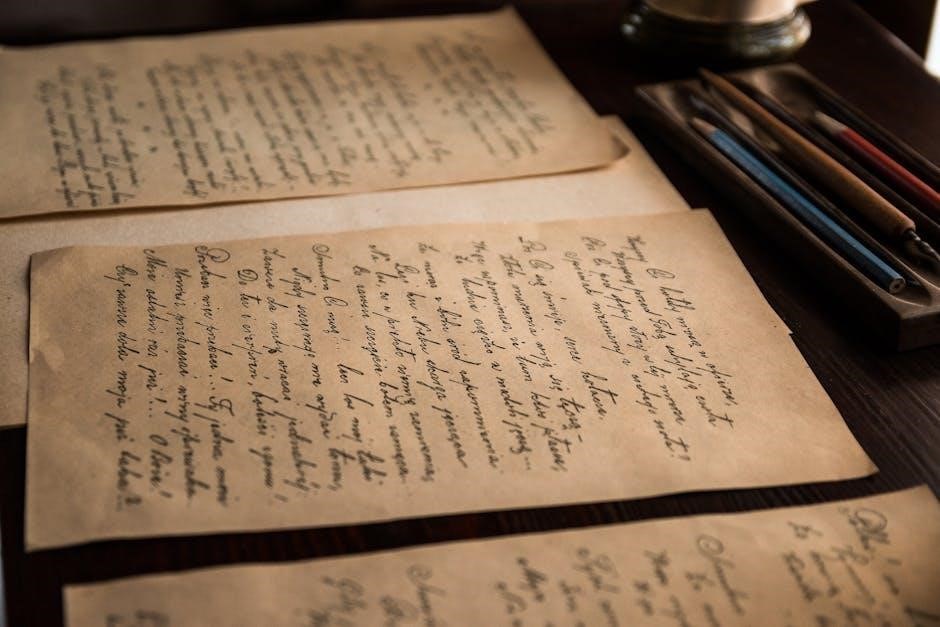
Examining the Sullivan Ballou letter’s PDF allows detailed scrutiny of his handwriting, revealing insights into his character and emotional state while composing such a profoundly personal document. The neat, yet hurried script suggests a man of education grappling with impending mortality.
Analyzing the letter’s format – the paper type, ink color, and layout – provides contextual clues about Civil War-era writing practices and the resources available to soldiers at the time. PDF versions facilitate zooming and enhancement for clearer observation of these details.
Furthermore, studying the letter’s physical appearance, as presented in the PDF, can illuminate any alterations or markings made after its creation, potentially revealing its journey through time and ownership. The letter’s structure, with its distinct paragraphs, reflects Ballou’s thoughtful organization of his final thoughts.
Further Research and Related Materials
Exploring related Civil War correspondence, alongside the Sullivan Ballou letter PDF, enriches understanding of soldier experiences and the era’s emotional landscape.
Other Civil War Letters
Comparing the Sullivan Ballou letter, readily available as a PDF, with other Civil War correspondence reveals common themes of love, loss, and the anxieties of wartime, offering broader context.
Letters from soldiers like Elisha Hunt Rhodes, documented in his diary and correspondence, provide contrasting perspectives on camp life and battlefield experiences, enriching historical understanding.
The letters of Sarah Emma Edmonds, disguised as a male soldier, offer a unique viewpoint, while correspondence from Confederate soldiers illuminates the opposing side’s motivations and hardships.
Examining these letters alongside the Sullivan Ballou PDF allows researchers to analyze variations in writing style, emotional expression, and the impact of differing circumstances.
Accessing digitized collections of Civil War letters, often in PDF format, facilitates comparative analysis and a more nuanced appreciation of the human cost of conflict.
These primary sources, like the Ballou letter, collectively paint a vivid picture of a nation divided and the individuals caught within its tumultuous struggle.
Biographies of Civil War Soldiers
Studying biographies of Civil War soldiers, alongside accessing the Sullivan Ballou letter as a PDF, provides crucial context for understanding his life and motivations, enriching the letter’s impact.
Biographies detailing the experiences of officers in the Rhode Island regiments, like Ballou’s, illuminate the challenges of leadership and the realities of command during the conflict.
Exploring the backgrounds of soldiers from similar socioeconomic classes and educational levels helps contextualize Ballou’s eloquent writing style and intellectual depth.
Understanding the pre-war lives of soldiers, their families, and their communities offers insights into what they were fighting for and what they feared losing.
These biographical accounts, when considered alongside the Sullivan Ballou PDF, humanize the conflict and move beyond purely strategic or political narratives.
They reveal the individual stories behind the statistics, fostering a deeper empathy for those who served and sacrificed during the Civil War era.
Resources on 19th-Century American History
Utilizing resources on 19th-century American history, in conjunction with the Sullivan Ballou letter PDF, provides a broader understanding of the social, political, and cultural landscape of the Civil War era.
Scholarly articles and books detailing the causes of the Civil War illuminate the ideological tensions that fueled the conflict and shaped Ballou’s worldview.
Exploring the history of letter-writing practices in the 19th century contextualizes the significance of Ballou’s correspondence as a form of personal expression.
Resources on 19th-century American literature and rhetoric enhance appreciation for the stylistic nuances and emotional power of Ballou’s prose.
Accessing primary source collections, alongside the Sullivan Ballou letter PDF, allows for a more nuanced and comprehensive understanding of the period.
These resources collectively enrich the interpretation of the letter, moving beyond a singular narrative to a broader historical context.